The origins of artificial intelligence trace back to the mid-20th century, when visionaries like Alan Turing pondered whether machines could think like humans. In 1956, the Dartmouth Conference marked the official birth of AI as a field, bringing together scientists who dreamed of creating intelligent systems capable of learning, reasoning, and problem-solving. Over the decades, AI evolved from rule-based programs to machine learning algorithms that could analyze vast datasets, leading to breakthroughs in natural language processing and neural networks. By the 2010s, advancements in computing power and data availability fueled the rise of deep learning, setting the stage for today’s sophisticated AI tools that mimic human cognition in remarkable ways.
Fast-forward to the 2020s, and AI has permeated everyday life, from virtual assistants to recommendation engines. The explosion of large language models (LLMs), powered by innovations like transformers, has revolutionized how we interact with technology. Companies began integrating AI into search functionalities, addressing the limitations of traditional methods by enabling more intuitive, context-aware queries. This shift not only democratized access to information but also sparked debates on ethics, accuracy, and the future of human-AI collaboration. As we stand in 2026, AI’s origins remind us of its transformative potential, particularly in search, where it’s challenging long-standing giants.
Perplexity AI is an innovative AI-powered search engine that stands out as an “answer engine” rather than a traditional link aggregator. Launched in 2022, it leverages advanced natural language processing (NLP) and large language models to deliver direct, concise responses to user queries. Unlike conventional search tools, Perplexity focuses on synthesizing information from reliable sources, providing summarized answers complete with citations for transparency and verification. This makes it particularly appealing for researchers, students, and professionals who need accurate, quick insights without sifting through endless pages.
In essence, Perplexity AI acts like a smart research assistant. It interprets complex questions in natural language, pulls real-time data from the web, and generates conversational replies. Features like follow-up questioning turn searches into dialogues, enhancing user experience. By 2026, Perplexity has gained significant traction, boasting millions of users who appreciate its hallucination-free responses—thanks to its grounding in verifiable sources. For businesses, this means exploring perplexity seo strategies to ensure visibility in this evolving landscape.
Perplexity AI operates through a sophisticated process that combines retrieval-augmented generation (RAG) with AI reasoning. When a user enters a query, the system first uses NLP to understand the intent behind the words, going beyond mere keywords to grasp context and nuances. It then scans the web in real-time, fetching data from high-quality sources rather than relying on a static index. This dynamic approach ensures freshness and relevance.
Next, the AI model synthesizes the gathered information, generating a coherent answer while embedding citations for each claim. Users can click these to access original content, promoting trust. The conversational aspect allows refining searches with follow-ups, like “Explain more about that point,” making it interactive. In 2026, enhancements like image generation and document analysis have made Perplexity even more versatile, rivaling traditional engines in speed and depth. For marketers, understanding this workflow is key to leveraging perplexity ai seo effectively.
Traditional search engines like Google and Bing have dominated the information retrieval space for decades. Google, founded in 1998, revolutionized search with its PageRank algorithm, prioritizing pages based on links and relevance. Bing, Microsoft’s offering since 2009, emphasizes visual search and integration with its ecosystem, often providing a more multimedia-focused experience. Both rely on massive indexes of web pages, crawled and stored for quick access.
These engines serve billions of queries daily, powering everything from casual lookups to critical research. However, their core model—delivering ranked lists of links—has remained largely unchanged, even as user expectations evolve. In 2026, while they’ve incorporated AI elements, traditional engines still face criticism for ad-heavy results and occasional inaccuracies. Businesses optimizing for them must now consider perplexity seo services to adapt to the shifting paradigm.
Google and Bing represent the pinnacle of traditional search technology. Google processes over 8.5 billion searches per day, using complex algorithms that factor in user location, history, and hundreds of signals to rank results. Its strength lies in comprehensiveness, from local business listings to knowledge graphs. Bing, with a smaller but loyal user base, excels in areas like image search and rewards programs, integrating seamlessly with Windows and Office tools.
Both have evolved to include features like featured snippets and voice search, but their foundation is keyword-driven. In 2026, Google’s dominance holds at around 90% market share, yet challenges from AI alternatives are mounting. Bing’s AI enhancements, like Copilot, blur lines but still anchor in link-based outputs. For SEO experts, partnering with a perplexity seo firm can bridge strategies between these giants and emerging AI platforms.
Traditional search engines function through a multi-step process: crawling, indexing, and ranking. Crawlers, or bots, scour the web to discover and fetch pages, which are then indexed in vast databases. When a user queries, the engine matches keywords against this index, applying algorithms to rank results based on relevance, authority, and user signals like click-through rates.
This system excels at scale but often requires users to navigate multiple sites for complete answers. Ads and sponsored content can clutter results, and personalization sometimes creates echo chambers. In 2026, while efficient, traditional methods struggle with conversational queries, highlighting the need for perplexity ai seo services to prepare for AI-driven shifts.
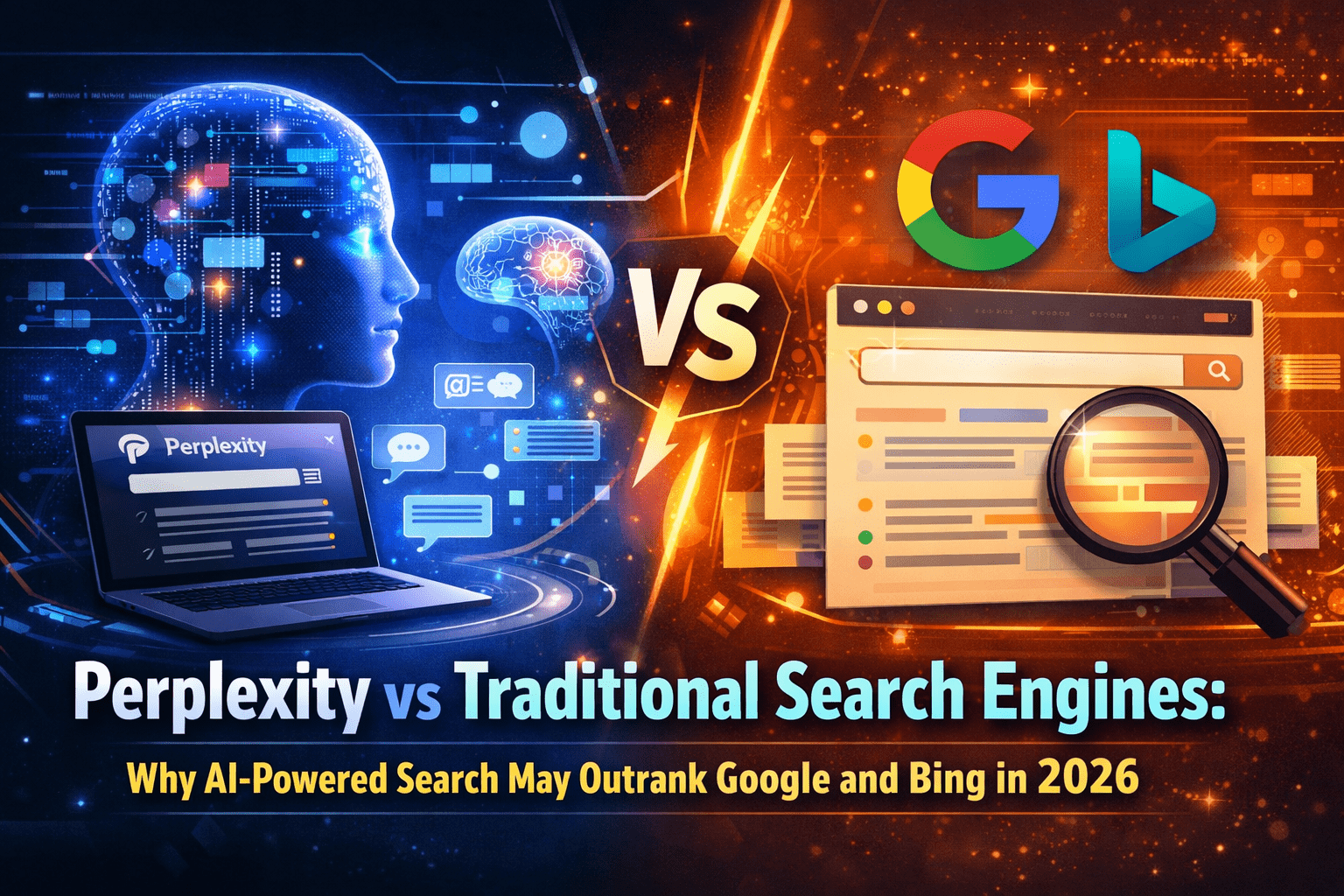
Perplexity AI fundamentally differs by prioritizing direct answers over link lists. Traditional engines like Google and Bing match keywords and rank pages, often leaving users to extract information themselves. Perplexity, however, interprets intent using AI, synthesizes data, and delivers cited summaries, reducing research time.
Another key distinction is real-time data retrieval versus static indexing. Perplexity avoids outdated info by fetching live sources, while traditional ones update indexes periodically. Conversational follow-ups make Perplexity more user-friendly, fostering deeper exploration. In 2026, this approach is why many predict it could outrank incumbents, emphasizing the value of perplexity seo service.
| Aspect | Perplexity AI (Answer Engine) | Traditional Search Engines (Google & Bing) |
| Primary Output | Direct, synthesized answers & summaries with inline citations | Ranked list of links (blue links), plus some featured snippets/AI overviews |
| Approach to User Query | Interprets natural language intent & context using AI (NLP & LLMs) | Primarily matches keywords & ranks pages based on algorithms (e.g., PageRank, BERT) |
| Information Delivery | Delivers concise, ready-to-use answers; user often gets complete info without clicking | Requires users to click through multiple pages & extract information themselves |
| Data Retrieval Method | Real-time web fetching & Retrieval-Augmented Generation (RAG) for up-to-date info | Relies on periodic crawling, static indexing & periodic updates (can lead to outdated results) |
| Conversational Features | Supports follow-up questions in a natural dialogue (threaded conversation) | Limited conversational follow-ups; mostly one-off queries (though improving with AI modes) |
| Ads & Distractions | Minimal/no intrusive ads (focus on clean, focused answers) | Heavy ad integration, sponsored results, & clutter (often first results are paid) |
| Citation & Transparency | Always includes verifiable sources & citations for every claim | Citations in AI Overviews/Copilot are present but less consistent/inline; links are the main trust signal |
| Research Time & Efficiency | Significantly reduces time (often 5-30 seconds for full answer) | Can take minutes as users navigate & synthesize info |
| Strengths in 2026 | Ideal for research, complex questions, accuracy-focused tasks; predicts to challenge incumbents | Excellent for local searches, quick facts, maps, shopping, & broad discovery |
| Impact on SEO | Rewards high-quality, fresh, authoritative, cited content (emphasizes perplexity seo service optimization) | Focuses on traditional factors like backlinks, keywords, & on-page SEO |
Keywords are specific terms users type into search engines to find information, forming the backbone of traditional SEO. They drive rankings based on relevance and competition. Prompts, in AI contexts like Perplexity, are natural language instructions or questions that guide the AI to generate responses, allowing for more nuanced interactions.
Understanding both is crucial: keywords optimize for volume, while prompts enable conversational depth. In 2026, blending them optimizes for hybrid searches.
Google and Bing have integrated AI to enhance their offerings. Google’s Search Generative Experience (SGE) uses AI to generate overviews, while Bing’s Copilot provides chat-based answers. However, they still rely on link ecosystems. To compete, they could fully adopt RAG-like models for cited, direct responses, but legacy structures limit agility. In 2026, AI integration might close gaps, but Perplexity’s pure AI focus gives it an edge.
As AI search gains momentum, SEO for Perplexity AI is essential for visibility. Traditional tactics may falter as users shift to answer engines.
By 2026, AI search users have surged, with Perplexity alone boasting over 100 million monthly actives. This growth stems from frustration with ad-cluttered results, driving adoption among millennials and Gen Z who prefer quick, accurate answers.
AI search could reduce organic traffic by 20-30%, as users get answers without clicking through. Sites must optimize for being cited in AI responses to maintain referrals.
Users now favor conversational queries, expecting synthesized info. This shifts from keyword hunting to natural questioning, altering content creation.
Zero-click searches, where answers appear directly, challenge brands. Strong citations in Perplexity enhance visibility, even without visits, building trust.
Perplexity ranks based on AI evaluation of relevance, not just links. It prioritizes sources that align with query intent through quality signals.
High-quality, fact-checked content ranks higher. Perplexity favors accurate, in-depth pieces over superficial ones.
Established domains with E-A-T (Expertise, Authoritativeness, Trustworthiness) are preferred. Backlinks and reputation matter.
Recent updates signal relevance; Perplexity pulls timely data.
Schema markup helps AI parse content, improving extractability.
Concise, readable prose aids AI comprehension.
Well-referenced content boosts credibility, mirroring Perplexity’s own citation style.
Formats like in-depth guides, FAQs, and listicles excel, as they provide structured, extractable info. Visuals with alt text and data tables enhance usability. Podcasts and videos transcribed into text also rank well, as AI can summarize multimedia.
Shift from short-tail keywords to long-tail, question-based phrases. Research prompts users might use, incorporating natural language. Tools like Perplexity itself can reveal trends. Balance with traditional keywords for hybrid optimization.
Start with authoritative content creation. Use structured data, ensure mobile-friendliness, and update regularly. Build citations through partnerships. Monitor AI mentions via analytics. Engage a perplexity seo expert for tailored strategies.
Here are the key points for How to Optimize Your Website for Perplexity AI:
These are the core actionable points that are delivering results in January 2026. Focus on quality + freshness + structure first — everything else builds from there.
In 2026 and beyond, SEO will evolve toward AI-first optimization, emphasizing semantic relevance over backlinks. Perplexity and other LLMS may dominate, forcing Google and Bing to adapt. Brands succeeding will focus on value-driven content, ethical AI use, and multi-platform strategies. The future is conversational, accurate, and user-centric—embrace it with perplexity ai seo to stay ahead.
Elevate your online presence with Conversion Seed trusted Digital Matketing strategies and solutions.