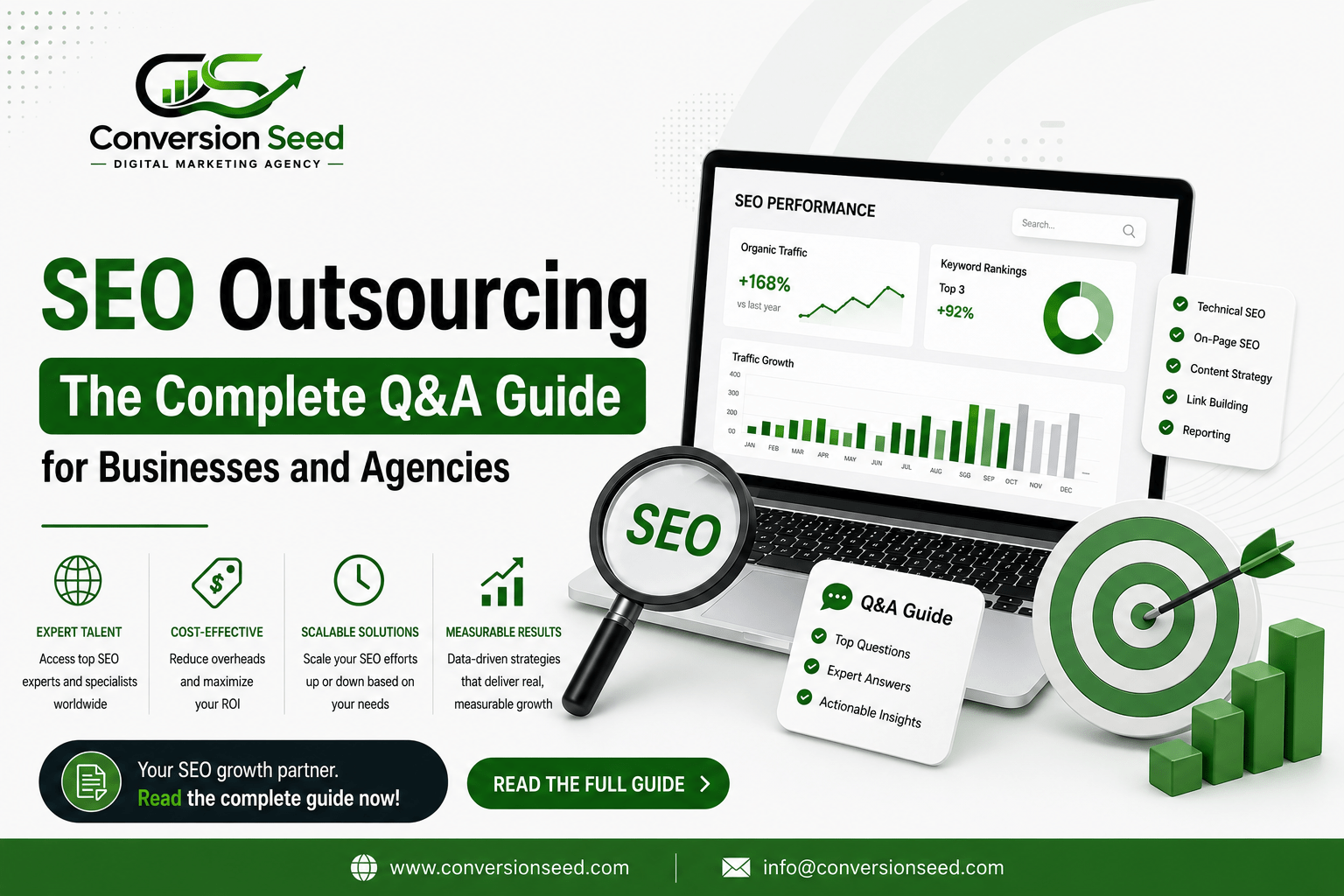
Outsourcing SEO is no longer a simple buy-vs-build decision — it’s a landscape of pricing models, white-label platforms, freelance marketplaces, and increasingly, AI search visibility requirements that didn’t exist a few years ago. Whether you’re a small business owner trying to find a trustworthy agency, an in-house marketer evaluating a freelance specialist, or an agency owner exploring white-label partnerships to scale your own offering, the questions are largely the same: what should this cost, how do I vet a provider, what tools and deliverables should I expect, and how do I avoid getting burned by red flags that are easy to miss until it’s too late.
This guide pulls together 48 of the most commonly asked questions about SEO outsourcing and answers each one with current 2026 market data, pricing benchmarks, and practical vetting frameworks drawn from practitioners across the industry. From understanding realistic monthly costs and payment structures to identifying red flags in contracts, evaluating technical SEO expertise, and managing remote teams across time zones, each answer is designed to be a quick, standalone reference — so whether you’re just starting your search or already managing an outsourced relationship, you can jump straight to what’s relevant to you.
Let me know if you’d like this added directly into the docx as a title page and intro section.
A practitioner’s guide to selecting, managing, and getting ROI from outsourced SEO partners — based on 2026 market data, pricing benchmarks, and vetting practices.
After two decades in this industry, the same advantages keep showing up: access to specialist skill sets (technical SEO, content, link building, and now AI search optimization) that would cost a fortune to hire in-house; faster execution because agencies run dedicated teams instead of one generalist marketer; and access to enterprise-grade tools like Ahrefs, Semrush, and Botify that most businesses can’t justify buying themselves.
SEO outsourcing also lets internal teams focus on strategy and product while execution happens in parallel. The biggest hidden benefit is exposure to cross-client pattern recognition, agencies that work across industries spot algorithm shifts and AI Overview changes weeks before a single in-house team would notice.
Start by checking how the agency talks about itself, not just what it promises you. Reputable agencies are transparent about methodology, give realistic timelines (SEO takes months, not days), and never guarantee specific rankings, since no one controls Google’s algorithm. Ask for case studies with named clients and real metrics, not anonymized screenshots.
Check third-party review platforms like Clutch and G2, and look for agencies that publish their own SEO results, since an agency that can’t rank its own site is a warning sign. For small businesses, prioritize agencies that specialize in your business size rather than ones built primarily for enterprise accounts, the workflows and pricing models differ significantly.
Pricing in 2026 spans a wide range depending on business size and scope. Monthly SEO retainers generally run from $1,500 to $15,000 or more, with small businesses typically paying $2,500 to $5,000, mid-market companies investing $5,000 to $10,000, and enterprise organizations spending $10,000 to $50,000 or more.
Hourly consulting rates for US agencies typically fall between $100 and $250 per hour, while project-based work can range from $5,000 to $50,000. For most legitimate providers, a serious small-to-midsize campaign costs roughly $1,500 to $5,000 per month, with local campaigns often starting lower. Offshore SEO outsourcing can run significantly cheaper, but quality and communication tradeoffs need careful vetting.
For freelance SEO talent, general marketplaces like Upwork, Fiverr, and Toptal remain the most accessible starting points, though quality varies enormously and vetting is on you. More specialized routes include SEO-focused community job boards (Traffic Think Tank’s job board, Online Geniuses Slack community), LinkedIn searches filtered by SEO certifications and agency alumni, and remote-talent staffing firms that pre-vet SEO specialists for ongoing retainer work.
When evaluating freelancers, ask for a live audit of your own site as a paid trial project rather than relying on portfolio screenshots, this reveals their actual process, tool fluency, and communication style before you commit to a longer engagement.
Yes, white-label SEO is a mature category built specifically for agencies that want to resell SEO under their own brand without building an internal team. White label SEO services let digital agencies, web design studios, PPC firms, and freelance marketers scale their offering without scaling headcount, with the agency reselling the service, setting its own pricing, and managing the client relationship while the end client never knows a third party is involved.
Among the most established providers in 2026 are DashClicks and The HOTH, alongside firms like Boostability, WebSpero Solutions, Thrive, Loopex Digital, Markitors, and Logic Inbound. The right fit depends on your client mix and how much hands-on account management you need from the partner.
Local SEO outsourcing has matured into its own specialty, separate from general organic SEO, because it requires Google Business Profile management, citation building, and review strategy on top of standard on-page work. BrightLocal is widely regarded as the go-to platform for local SEO specialists, offering map pack rank tracking, citation management, and review monitoring.
When evaluating providers, prioritize firms that can show ranking improvements specifically in the local map pack (not just organic results), have experience with multi-location businesses if relevant, and include Google Business Profile optimization as a core deliverable rather than an add-on. Local SEO outsourcing tends to be more affordable than national campaigns, but pricing should still reflect ongoing citation cleanup and review management workload.
SEO audit and strategy work is increasingly offered as a standalone engagement before any retainer begins, which is a smart way to evaluate a provider before committing. Look for firms that combine technical crawling (using tools like Screaming Frog, Sitebulb, or Botify for larger sites) with content gap analysis, backlink profile review, and increasingly, AI search visibility assessment across ChatGPT, Perplexity, and Google AI Overviews.
Providers built around tools such as Semrush, Ahrefs, Lumar, Sitebulb, Conductor, and Botify each bring different strengths, with Botify in particular suited to large, complex sites needing deep technical analysis. A strong audit should end with a prioritized action plan tied to business impact, not just a list of errors.
Beyond general freelance marketplaces, several platforms focus specifically on pre-vetted marketing talent. Toptal and Growth Collective screen candidates before they’re listed, which reduces vetting time but typically comes at a premium rate. SEO-specific staffing and remote-talent firms have also grown significantly, matching businesses with experienced specialists from regions like Latin America, Eastern Europe, and Southeast Asia who work US hours.
Nearshore talent from Latin America is often favored for fast communication and technical SEO execution because most US clients align with similar time zones and communication styles. Whichever marketplace you use, request a paid trial task before signing a long-term contract.
E-commerce SEO outsourcing requires a different skill set than general SEO, since it involves SKU-level optimization, faceted navigation, product schema, and managing thousands of pages at scale. A strong e-commerce SEO agency should demonstrate SKU-level strategy, schema implementation depth, and AI search visibility tracking, and should report on organic revenue by landing page type rather than just rankings and traffic.
Red flags specific to this niche include agencies that treat product description writing as an afterthought, ignore Core Web Vitals on category pages, or can’t explain how they’ll handle pagination and duplicate content across filtered URLs. Ask any e-commerce SEO provider for a case study involving a catalog similar in size to yours.
B2B SEO outsourcing succeeds or fails on intent targeting, not traffic volume. Generic keyword targeting that chases broad definitional searches makes traffic graphs go up but ignores buyer intent, while content built around comparison and decision-stage queries drives qualified pipeline instead. Be skeptical of agencies requiring 12-month commitments, since the strongest providers offer 30-90 day terms and remain confident they can demonstrate month-over-month results.
Also evaluate whether the agency’s content samples show genuine vertical expertise or generic boilerplate. For B2B specifically, ask whether the provider’s reporting connects organic traffic to actual sales pipeline, not just impressions and clicks.
Clutch.co and G2 remain the most widely cited third-party review platforms for SEO agencies, since both verify reviewer identities and require detail about project scope and budget. Industry publications like Search Engine Land and Search Engine Journal regularly publish ranked agency lists and case study roundups, which are useful for understanding methodology trends even if the rankings themselves involve some promotional placement.
When reading reviews, weight recent ones more heavily, since SEO agency quality can shift significantly after acquisitions or leadership changes, and watch for patterns in complaints (communication gaps, reporting delays) that repeat across multiple reviewers rather than one-off issues.
Enterprise technical SEO requires tools that go beyond basic crawling. Botify is designed for enterprise SEO teams needing deep visibility into technical site health and crawlability, especially for large ecommerce sites, publishers, and organizations with complex web architectures, helping identify crawl issues, optimize site structure, and monitor how search engines interact with pages at scale.
Screaming Frog remains the best tool for site crawling and audits at scale, while Lumar, Botify, and Oncrawl are considered the strongest enterprise-level technical SEO platforms, alongside AccuRanker for real-time rank tracking across locations and devices. A provider lacking experience with log file analysis and JavaScript rendering issues isn’t equipped for enterprise sites.
For senior, strategy-level SEO consultants rather than execution-focused freelancers, the best sources tend to be referral networks within SEO communities, LinkedIn outreach to people who’ve held in-house SEO leadership roles at recognizable brands, and consulting marketplaces like Toptal that specifically screen for seniority.
Conference speaker lists (from events like BrightonSEO or SearchLove) are also an underused sourcing channel, since consultants who speak publicly tend to have demonstrable expertise you can verify. For highly experienced consultants, expect hourly rates well above typical freelance platform averages, but the strategic guidance can prevent costly missteps in technical migrations or penalty recovery.
The most revealing questions in 2026 go beyond tools and timelines. The most telling question is whether the agency has applied its own methodology to its own brand, not just client work, since any agency that cannot articulate a clear AI Overview strategy is selling an outdated service.
Also ask: who specifically will work on the account and how many other accounts do they handle, where will backlinks come from and how are sources vetted, and how is success measured beyond rankings and traffic. Red flag answers include guaranteed rankings, proprietary methods they won’t explain, and anonymous case studies without named metrics.
Most outsourced SEO is sold as a monthly retainer, which suits ongoing work like content production, technical maintenance, and link building since SEO compounds over time rather than completing in discrete tasks. Project-based pricing fits one-time work like audits, migrations, or penalty recovery, where scope is well-defined upfront. Hourly consulting suits businesses that need strategic guidance but have an internal team for execution.
Performance-based or pay-for-results models exist but are controversial, since tying payment purely to rankings can incentivize short-term tactics; a contract based on directional KPIs tied to business impact is generally considered superior to one offering ranking guarantees, which no longer correlate directly with traffic or revenue given how AI Overviews capture attention above traditional results.
A modern professional SEO stack typically combines Google Search Console, Ahrefs, Semrush, Screaming Frog, Sitebulb, Surfer SEO, Clearscope, MarketMuse, AccuRanker, BrightLocal, and SE Ranking, covering keyword research, technical SEO, content optimization, and reporting.
Common configurations pair Screaming Frog, Sitebulb, Oncrawl, Lumar, or ContentKing for technical monitoring with Semrush, Ahrefs, SE Ranking, or seoClarity as all-in-one platforms, MarketMuse for content planning, and AccuRanker for rank tracking. Increasingly, agencies are layering in AI visibility tracking tools that monitor citation rates across ChatGPT, Perplexity, and Google AI Overviews, since this has become a core deliverable rather than an optional extra.
Extremely cheap SEO is rarely a bargain. Agencies that charge well below market rates are typically either cutting corners on deliverables, using tactics that can trigger penalties, or planning to upsell aggressively once a client is locked into a contract, and the consequences of cheap link schemes have become more severe following recent algorithm updates.
If an agency charges around $300 a month, they’re realistically allocating only two to three hours to the account, which limits what meaningful work can be accomplished, and the math becomes clearer when you consider that an average SEO specialist earns roughly $70,000 annually. The real cost of cheap SEO is often the cleanup required afterward.
Performance monitoring in 2026 needs to extend beyond traditional rankings dashboards. Effective measurement looks at ranking velocity, organic traffic trend, conversion or revenue attribution, AI citation share across at least three AI platforms, and clear quarter-over-quarter deltas, while generic vanity charts showing impressions up with no context are a red flag.
A strong reporting framework ties measurement to business outcomes such as qualified pipeline, revenue attributed to organic search, AI citation share in target query sets, share of voice in branded searches, and customer acquisition cost trends. Set up a shared dashboard with access to raw data (GSC, GA4) rather than relying solely on agency-curated reports.
Most SEO vendors operate on month-to-month or quarterly retainer agreements with a defined scope of deliverables (content volume, technical fixes, link acquisition targets, reporting cadence). Some require longer initial commitments, typically three to six months, to account for SEO’s lag time before results appear.
Term locks of 12-24 months with no exit clause are increasingly viewed as protecting underperforming work, with a 6-month initial term and quarterly review gates considered a healthier standard. Agreements should also specify data ownership (you should retain access to analytics and search console accounts), reporting frequency, and clear escalation paths if deliverables slip.
When evaluating case studies from SEO providers, look past the headline traffic increase and check whether the agency connects organic growth to business metrics like leads, revenue, or customer acquisition cost over a realistic timeframe, generally six to twelve months given how SEO compounds. Strong case studies include named clients and specific metrics rather than anonymized screenshots, since anonymous case studies without named results are themselves considered a red flag in vetting. Ask providers directly for references you can contact, particularly clients in a similar industry or site size to yours, and ask those references about communication quality and how the agency handled periods when results plateaued.
Large agencies typically offer broader service coverage (SEO alongside PPC, social, and design), more account management layers, and the resources to handle enterprise-scale technical work across multiple markets or languages. The tradeoff is often less senior attention on any single account and more standardized processes. A common complaint is that during sales, clients meet the founder, but after signing they’re handed to a junior account manager with no direct access to decision-makers. Boutique consultancies tend to offer more senior, hands-on involvement and deeper specialization in a niche or vertical, but may have less bench strength for sudden scope increases or multi-channel needs. Neither model is inherently better, fit depends on your business size and how much oversight you want to provide.
The smoothest integrations treat the outsourced team as an extension of internal marketing rather than a separate silo. Establish a single point of contact on both sides, share access to a common project management tool rather than relying on email threads, and create a shared content calendar so SEO recommendations align with broader marketing and product launches. Give the external team direct (read-only where appropriate) access to analytics, search console, and CMS rather than routing every request through a gatekeeper, this is one of the most common sources of delay. Finally, schedule a recurring sync (biweekly is typical) focused on priorities and blockers, not just reporting metrics.
Time zone overlap is the most immediate issue, particularly when working with teams in regions with minimal business-hours overlap with the US. This is part of why nearshore talent from Latin America has grown in popularity, since most US clients align with similar time zones and cultural communication styles compared to teams further afield. Language nuance can also affect content quality for native-English markets, even when technical English is strong. Practical mitigations include establishing asynchronous documentation as the default (so decisions don’t depend on live meetings), using recorded video updates for complex explanations, and being explicit about brand voice guidelines in writing rather than assuming tone will translate naturally.
A comprehensive package typically spans four pillars: technical SEO (site audits, Core Web Vitals, crawlability, schema markup), on-page optimization (title tags, internal linking, content structure), content strategy and production (keyword-targeted articles, landing pages, topic clusters), and off-page work (link building, digital PR, brand mentions). A full suite often covers technical audits, content optimization, link building, local search, and ongoing performance management without requiring the client to build an internal team. In 2026, comprehensive packages increasingly add a fifth pillar: AI search optimization, ensuring content is structured to be cited by AI Overviews, ChatGPT, and Perplexity alongside traditional rankings.
A practical way to pressure-test technical competence is to ask how the provider would run an audit on your site and what they would fix first, since their prioritization reveals how they think about impact versus effort. Ask specifically about their experience with JavaScript-rendered sites, log file analysis, and Core Web Vitals remediation, these separate genuinely technical providers from content-focused agencies that label themselves technical. Request a sample of a recent technical audit (with client details redacted) to see the depth and clarity of their findings. A strong technical partner explains issues in terms of business impact, not just a checklist of errors flagged by a crawler.
Beyond standard contract terms, overseas SEO contracts should clearly address data protection compliance (especially if customer data is involved, given GDPR and similar regulations across jurisdictions), intellectual property ownership of content and strategy documents created during the engagement, and which jurisdiction’s laws govern disputes. Payment terms should account for currency fluctuation if invoicing isn’t in your local currency. It’s also worth confirming whether the provider subcontracts work further (a common practice in offshore SEO) and whether confidentiality obligations extend to those subcontractors. A termination clause with a clear handover process protects you if the relationship ends.
Standard deliverables include a content calendar mapped to keyword and topic research, a defined volume of published content (articles, landing pages, or both) per month, on-page optimization for both new and existing content, and internal linking strategy connecting new content to priority pages. Monthly or quarterly reporting should cover content performance (traffic, rankings, and increasingly AI citation visibility), not just publication counts. Good providers can show a topic map and explain how each piece supports a cluster, strengthens internal linking, and moves prospects toward a conversion page, rather than producing content for content’s sake. Ask whether content briefs and drafts go through a review step before publishing.
Scaling organic search through outsourcing usually works best in phases rather than handing over everything at once. Many businesses start with a defined, contained workstream (content production or technical fixes) to evaluate quality and communication before expanding scope to link building or full strategy ownership. Outsourcing is generally far more affordable than building an equivalent in-house team, and pricing scales with the size and competitiveness of the engagement, from smaller starter packages up to enterprise-level campaigns. As scope grows, ensure your internal team retains strategic oversight and access to all data and accounts, so the relationship remains a partnership rather than a black box you depend on entirely.
The most meaningful KPIs combine ranking velocity and organic traffic trend with conversion or revenue attribution, AI citation share across multiple AI platforms, and quarter-over-quarter deltas rather than static snapshots. Branded search volume and share of voice against competitors are useful leading indicators of growing brand awareness. For e-commerce, organic revenue by page type matters more than aggregate traffic. For lead-gen businesses, track marketing-qualified leads sourced from organic channels, not just form fills. Avoid over-indexing on keyword rank position alone, since position #1 means little if an AI Overview captures the user’s attention above it.
Go beyond the testimonials an agency chooses to publish. Request direct references and ask those clients specific questions: how quickly did the agency respond to issues, did reporting match actual business results, and would they renew the contract today. Cross-check case study claims against publicly available data where possible, for instance, if an agency claims to have driven a traffic increase for a named client, tools like Ahrefs or Similarweb can sometimes corroborate general traffic trends. Use a structured scorecard to compare agencies objectively, since gut feel alone leads to expensive mistakes, and weight references from businesses similar in size and industry to yours most heavily.
Build asynchronous communication into the workflow as the default, not the exception. Maintain a shared project management tool (Asana, ClickUp, or similar) where tasks, statuses, and feedback are documented in writing, so progress doesn’t stall waiting for a live overlap window. Establish a recurring meeting time that, while imperfect for one side, is scheduled consistently so it becomes a predictable rhythm rather than a scheduling negotiation each time. Document decisions and approvals in writing immediately after any live discussion to avoid ambiguity. Choosing partners in nearshore regions with closer time zone alignment can reduce these friction points significantly for US-based businesses.
Performance-based contracts work best when tied to business outcomes rather than ranking positions, which the agency doesn’t fully control. Directional KPIs focused on business impact are considered superior to outdated ranking guarantees, which no longer correlate reliably with traffic or revenue given how AI Overviews now capture user attention above traditional results. A practical structure combines a base retainer covering ongoing execution costs with a smaller variable component tied to metrics like organic traffic growth, qualified leads, or revenue from organic channels, measured against an agreed baseline and timeframe (typically 6-12 months). Ensure the contract clearly defines how each metric is measured and which analytics source is the source of truth.
Certifications matter less than demonstrated results, but they can signal baseline competence and ongoing education. Google’s own certifications (Google Analytics, Google Ads) indicate familiarity with core measurement tools, even though Google doesn’t offer a formal ‘SEO certification.’ Platform certifications from Semrush, Ahrefs, Moz, and HubSpot indicate tool proficiency. Being a certified Google Partner is sometimes highlighted by agencies as a credibility marker, though it’s more commonly associated with paid media than organic SEO. More telling than certificates is whether team members actively engage with the SEO community (conference speaking, published research, contributions to industry publications), which suggests genuine expertise rather than checkbox credentials.
The most common pitfall is an incomplete handover of historical context, past strategies, what’s been tried before, and why certain decisions were made get lost, leading the new provider to repeat dead-end experiments. Ensure access to historical analytics data, previous audits, and content performance history is transferred, not just current account access. Another frequent issue is unclear ownership of in-progress work during the transition window, leading to gaps in publishing or technical monitoring. Finally, avoid switching providers and making major strategic changes simultaneously, isolate variables so you can attribute performance changes to the new provider’s work rather than confounding factors.
Budget allocation generally scales with business size and competitive intensity rather than following a fixed percentage of revenue, though some marketing teams benchmark SEO spend against overall digital marketing budget (often 10-20% for organic-focused businesses). Enterprise SEO programs commonly range from roughly $2,000 to $20,000 or more per month based on 2026 agency surveys, with the higher end reserved for highly competitive industries or large site footprints. Many businesses allocate budget in phases, starting with audit and quick technical wins, then scaling investment into content and link building once early performance data validates the approach and ROI becomes clearer.
Request direct access to the analytics and search console data behind any reported metric rather than relying solely on agency-generated reports, this is the single most reliable verification method. For ranking claims, independently check positions using a rank tracker you control, not just the agency’s tool. For backlink claims, review the actual links in a tool like Ahrefs or Semrush to assess quality and relevance, not just quantity. If an agency cannot tell you where backlinks come from, the quality of those sources, and how they’re vetted, they’re likely buying low-quality links that will eventually trigger a penalty. Cross-reference case study results against public traffic estimation tools where feasible.
Start with a detailed, written brand voice guide that includes example sentences, terminology to use and avoid, and tone guidance for different content types, don’t assume tone will transfer through verbal briefings alone. Provide a style guide and a glossary of industry-specific terms, especially important for technical or regulated industries. Build in a structured review step where initial drafts are checked against both SEO requirements and brand voice before publishing, and provide specific feedback on early pieces so the provider can calibrate. Be wary if sample content reads as generic boilerplate, since strong content demonstrates genuine vertical expertise rather than surface-level industry references.
Asana, ClickUp, and Monday.com are the most commonly used platforms for SEO project management, offering task tracking, content calendars, and approval workflows suited to recurring SEO work. For technical SEO specifically, some agencies integrate crawl data and audit findings directly into ticketing systems like Jira so fixes route to development teams. Tools like Botify integrate with platforms including Agency Analytics, Pitchbox, Google Sheets, and Databox, reflecting how technical SEO findings increasingly flow into broader project management ecosystems rather than living in standalone reports. The right tool matters less than consistent usage, pick one system as the single source of truth and avoid splitting communication across email, Slack, and the project tool simultaneously.
Onboarding typically begins with access provisioning, granting the provider access to Google Search Console, Google Analytics, the CMS, and any existing SEO tools, followed by a discovery phase where the provider conducts an initial audit and reviews historical performance and past strategies. Most providers then present an initial strategy or roadmap for the first 90 days, often focused on technical quick wins while longer-term content and link building plans are developed in parallel. Expect onboarding to take two to four weeks before regular execution begins. A good provider will also use this period to align on reporting cadence, KPIs, and communication channels before work scales up.
Technical SEO outsourcing works best when the specialist firm has direct (or closely coordinated) access to development resources, since many fixes require code or CMS changes that the SEO team can’t implement alone. Specialist tools focused on JavaScript SEO, indexation analysis, and crawl budget such as Botify, OnCrawl, and Lumar are recommended when these issues are central to the engagement. Establish a clear handoff process for findings, ideally tickets that go directly into your development backlog with priority levels attached, rather than PDF reports that sit unread. Regular re-crawls after fixes are deployed are essential to confirm issues are actually resolved, not just marked complete.
Smaller businesses don’t always need a full agency relationship. Fractional SEO consultants who work a set number of hours monthly can provide strategic direction while the business handles execution internally. SEO-focused freelancers for specific deliverables (content writing, link building, technical audits) let businesses build a customized stack without retainer overhead. Software platforms like SE Ranking are positioned as suitable for small businesses, providing keyword research, audits, rank tracking, backlink monitoring, and reporting at an affordable price for teams handling SEO themselves. A hybrid model, software plus periodic consultant check-ins, often costs less than a full agency retainer while still providing expert guidance.
Before an audit begins, prepare admin or appropriate-level access to Google Search Console and Google Analytics (or GA4), CMS access for content and metadata review, and any existing technical documentation (sitemaps, robots.txt configurations, past audit reports). If the site has undergone recent migrations, redesigns, or domain changes, document these with dates, since they often explain ranking fluctuations the audit team would otherwise have to investigate from scratch. Also prepare a list of known issues or areas of concern from your own team’s perspective, this helps the audit team prioritize and avoids them spending time rediscovering problems you’re already aware of.
A trustworthy provider explains their methodology rather than calling it a ‘proprietary process,’ specifying where backlinks will come from, the quality of those sources, and how they’re vetted, since vague answers around link building are one of the most common red flags in the industry. Ask for examples of recent link placements (with client details redacted if needed) and evaluate the relevance and authority of those sites relative to your industry. Digital PR-based link building, earning links through genuine media coverage or original research, tends to be more sustainable than guest post networks or paid link schemes, though it typically costs more and takes longer to show results.
Reputable agencies avoid guaranteeing specific rankings, since Google itself states that no one can guarantee specific positions in search results, and agencies that make this promise are widely considered a red flag. Instead, reputable SLAs focus on process commitments: response time to communications, reporting frequency and format, minimum content publication volume, and turnaround time for technical fixes once issues are identified. Some agencies offer a satisfaction guarantee tied to the first few months, allowing an exit without penalty if the relationship isn’t working. Directional, outcome-based KPIs are increasingly preferred over hard ranking guarantees as standard practice in service agreements.
Contracts should explicitly state that all content created under the engagement, articles, landing pages, graphics, and any proprietary research, becomes the client’s intellectual property upon payment, with the provider retaining no rights to reuse or resell the material. This is standard in most reputable agency contracts but worth confirming explicitly, particularly with overseas providers who may have different default assumptions. Also clarify ownership of any underlying strategy documents, keyword research, or audit findings, these sometimes get treated separately from published content in contracts. If the provider uses AI-assisted content generation, confirm this is disclosed and that resulting content doesn’t create third-party IP complications.
ROI calculation starts with attributing organic traffic and conversions to revenue using Google Analytics (or GA4) goal and ecommerce tracking, then comparing the resulting revenue against total SEO spend over the same period. More sophisticated approaches tie measurement to qualified pipeline, revenue attributed to organic search, AI citation share, and customer acquisition cost trends rather than traffic alone. Because SEO compounds over time, ROI calculations are most meaningful over 6-12 month windows rather than monthly snapshots, comparing performance against a pre-engagement baseline. For content-heavy programs, cost-per-piece versus traffic and conversions generated by that content over its lifetime provides a more granular ROI view than aggregate spend-versus-revenue alone.
The most significant red flags include guaranteed rankings, secretive ‘proprietary’ processes, senior-to-junior bait-and-switches after signing, vanity metric reporting, data hostage tactics where you can’t access your own analytics or search console, and unsubstantiated claims of AI SEO expertise. Additional warning signs include vague promises without timelines, reluctance to explain methods clearly, and pressure to sign long contracts before seeing any proof of capability. Generic content samples that read like AI could have written them without industry knowledge, and an inability to demonstrate any AI search testing framework, are increasingly significant red flags in 2026.
A strong enterprise SEO proposal should open with findings from a preliminary audit (even a high-level one) rather than a generic pitch, demonstrating the firm has actually looked at your site. Enterprise SEO programs in 2026 typically range from roughly $2,000 to $20,000 or more monthly based on agency surveys, and a credible proposal should justify its pricing tier against the specific scope of work, technical complexity, content volume, and competitive landscape. The proposal should detail team structure (who specifically works on the account), reporting framework tied to business KPIs, and a phased roadmap distinguishing quick technical wins from longer-term content and authority-building work. Ask for the proposal to explicitly address AI search visibility strategy alongside traditional organic goals.
Elevate your online presence with Conversion Seed trusted Digital Matketing strategies and solutions.