What ChatGPT SEO is, why it matters in 2026, and how ignoring AI-powered search costs revenue
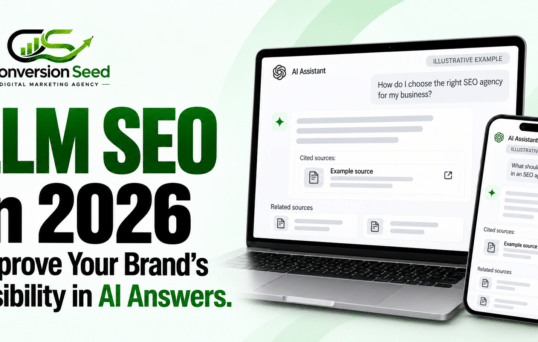
AI-driven assistants and “answer engines” no longer mirror web search results; they synthesize, rank, and recommend based on underlying language models, knowledge graphs, and citation networks. ChatGPT SEO is the set of strategies, technical implementations, and content systems designed to make your business a trusted source for those AI recommendations — appearing as citations, suggested links, and authoritative answers inside ChatGPT, Gemini, Claude, Perplexity and Google’s AI modes.
Why this matters in 2026
- AI assistants have become primary discovery tools for many users. People ask conversational models for recommendations, comparisons and local services — then act on those suggestions.
- Large language models (LLMs) and multimodal assistants prioritize concise, authoritative answers over long result lists. Being featured in those answers drives high-intent traffic and conversions.
- Brands that appear in AI answers capture early-stage demand and get preference signals that influence downstream traffic on traditional search engines.
The cost of ignoring AI-powered search
Companies that treat AI assistants as an afterthought are losing visibility, qualified leads, and brand authority. Without an explicit AI SEO strategy — entity optimization, citation networks, structured data and purposeful content clusters — you risk losing the first touchpoint with customers who now begin their journeys with conversational AI. Free AI Visibility Audit or Book a Strategy Call
What is ChatGPT SEO?
ChatGPT SEO targets visibility within LLM-powered search and recommendation systems. It combines technical SEO, content strategy and digital PR with entity-first optimization to meet the selection criteria of modern answer engines.
Core components of ChatGPT Search and AI recommendations
- ChatGPT Search / OpenAI Search: These systems use model-driven retrieval and citation pipelines to return concise answers sourced from vetted web pages, knowledge graphs and licensed content providers.
- AI recommendations: LLMs generate recommendations by combining topical knowledge, brand reliability signals and citation patterns. Recommendations often present a short list of trusted options, sometimes with direct links or “further reading.”
- How LLMs select sources: LLM pipelines rank sources based on topical authority, EEAT-like signals (experience, expertise, authoritativeness, trustworthiness), citation frequency and structured metadata. They also use hidden retrieval systems and knowledge graph connections to verify facts and surface sources.
Difference between traditional SEO and AI SEO
- Ranking signals: Traditional SEO emphasizes backlinks, keyword relevance and page-level technical metrics. AI SEO prioritizes entity relationships, knowledge graph presence, consistent citations and answer-ready content.
- Content format: SEO often favors long-form pages optimized for SERP features. ChatGPT SEO favors concise, cited answers, clear entity mentions and question-answer formatting that fits assistant responses.
- Visibility surface: Traditional search shows ranked lists with SERP features. AI assistants show synthesized answers and a few cited sources; being listed as a citation is more valuable than being #1 in a traditional SERP for many queries.
- Authority distribution: For AI, brand-level authority and cross-site citation networks matter more for trust than isolated backlinks.
Key areas of ChatGPT SEO
- Entity Optimization: Define and reinforce the entities (brand, people, products, services) that LLMs should associate with your business. Use consistent naming, metadata, and structured markup across web properties and authoritative third-party sources.
- Knowledge Graph Signals: Populate and optimize knowledge panels and knowledge graph entries (Google Knowledge Panel, Wikidata, DBpedia) and ensure accuracy across directories, social profiles, and publicly accessible data sources.
- Brand Authority: Build visible, verifiable brand mentions in reputable publications, directories, and industry resources to increase the likelihood of being cited by AI.
- Structured Data: Use schema.org markup (Organization, Product, Service, FAQ, HowTo, LocalBusiness, Review) to make your content machine-readable and answer-ready.
- Content Clusters: Create tightly themed topic clusters that answer core user intent and support pillar pages with strong internal linking to show topical depth.
- AI Citation Optimization: Design content specifically to be cited: short declarative statements, clear sources, timestamped facts, and cross-referenced research that LLM retrieval systems prefer.
Why your business needs ChatGPT SEO
- Increased AI Visibility: Appear directly inside AI answers where users ask conversational questions, gaining early-stage mindshare and trust.
- More Qualified Leads: Users who act on AI recommendations often have higher conversion intent; being recommended by an assistant increases lead quality.
- Brand Mentions in AI Answers: Even non-click citations increase brand recognition and perceived authority.
- Better Authority Signals: Citations and knowledge graph presence strengthen broader search authority.
- Future-Proof Search Strategy: As AI assistants grow, early investment in AI SEO preserves long-term organic visibility.
Market trends and statistics (2026 context)
- A growing share of search interactions start in chat-based assistants; estimates vary by market, but in many verticals 25–40% of discovery queries are AI-initiated.
- LLM citation systems now influence both direct traffic and referral patterns: pages cited by AI often see a 10–30% uplift in direct visits and branded searches.
- Businesses with active entity optimization and visible knowledge graph entries report higher trust metrics and increased conversions from assistant-driven queries.
(Include precise up-to-date statistics and source citations in final published page.)
How ChatGPT chooses websites — detailed factors
- Content quality: LLMs favor content that directly answers user intent, demonstrates topical depth, and shows verifiable facts. Content that uses clear headings, short answer snippets, and cited sources is more likely to be surfaced.
- Topical authority: A site that publishes many related, high-quality resources on a topic ranks higher in retrieval models. Topic clusters, consistent internal linking and domain-level coverage all contribute.
- EEAT signals: Experience, expertise, authoritativeness, trustworthiness. Author credentials, reputable bylines, transparent sources, and verified contact information all feed into model trust.
- Brand mentions: Frequency and context of brand mentions across authoritative sites help LLMs determine a brand’s real-world relevance to a query.
- Structured data: Machine-readable schema makes it easier for retrieval systems to extract facts and cite sources accurately.
- User experience: Fast-loading pages, mobile-friendly design, and low bounce rates help indicate a quality source; LLMs use proxy signals from web activity in certain retrieval systems.
- Citations across the web: A diverse, reputable citation network (press, industry resources, directories) improves the chance of being selected as a source for AI answers.
Explain each factor in detail
- Content quality: LLM pipelines use content parsing to detect precision and direct answers. Short paragraphs that deliver a clear fact or step and include supporting data, references, and a concise summary increase selection probability.
- Topical authority: Retrieval models compute topical relevance from a site’s cumulative content. A single article is less persuasive than ten high-quality articles covering subtopics, use cases, FAQs, and how-to guides.
- EEAT signals: Models assess authorship transparency, domain reputation, and third-party validation (reviews, expert endorsements). For sensitive verticals (health, finance, legal), EEAT-like signals are critical.
- Brand mentions: Mentions in news articles, industry roundups and government or educational sites add credibility. The context of mentions (contextual vs. directory-style) is important; context-rich mentions are more valuable.
- Structured data: Schema fields that include canonical names, identifiers (e.g., IBAN, NPI), addresses, and product specs help retrieval systems match queries to entities confidently.
- User experience: While LLMs don’t “see” UX like humans, they can consume telemetry from crawlers and search systems that includes engagement signals. Better UX correlates with stronger trust signals.
- Citations across the web: Citations act like mini-evidence chains. When multiple independent sites corroborate the same facts, models are likelier to present the content as trustworthy.
Our ChatGPT SEO process
We combine audit-driven analysis, technical fixes, content engineering and authority building. Our five-phase process is tailored to secure citations, knowledge graph presence and sustained AI visibility.
- AI Search Audit
- Current AI visibility: Analyze appearances in ChatGPT, Gemini, Claude, Perplexity and Google AI Mode. Identify queries where your brand is cited, suggested, or omitted.
- Brand mention analysis: Map brand mentions, context and sentiment across the web. Identify high-value publications and missed opportunities.
- Entity analysis: Evaluate your entity signals in Wikidata, Google Knowledge Graph, schema, and other public knowledge sources. Identify gaps, inconsistencies and conflicts.
Deliverables: AI visibility baseline, prioritized list of target queries, brand mention heatmap, entity discrepancy report.
- Technical AI SEO Optimization
- Schema implementation: Deploy and validate relevant structured data (Organization, Product, Service, LocalBusiness, FAQ, HowTo, Person, Review).
- Crawlability: Ensure content and knowledge pages are crawlable by common crawlers and accessible to model retrieval systems; fix robots and navigation issues.
- Indexation improvements: Optimize sitemaps, canonical tags and server responses to ensure LLM retrieval systems fetch the correct authoritative versions.
Deliverables: Schema rollout, crawlability report, indexation fixes log.
- Content Optimization
- AI-friendly formatting: Convert key facts and answers into concise snippets, bullet lists and short lead-ins suitable for assistant responses.
- Question-based content: Create and optimize FAQ and Q&A pages using conversational inputs that mirror real user prompts for assistants.
- Topic clusters: Build pillar pages and supporting clusters to demonstrate topical authority and maximize internal linking signals.
Deliverables: Optimized content pieces, new FAQ pages, content calendar and internal linking map.
- Authority Building
- Digital PR: Secure bylines, expert quotes, and feature articles in industry and mainstream media to grow high-quality citation networks.
- Brand mentions: Create distributed content (guest posts, product listings, interviews) to increase contextual brand mentions.
- Citation acquisition: Target authoritative directories, industry databases and reference pages to strengthen fact chains.
Deliverables: PR placements, citation acquisition list, outreach reports.
- AI Monitoring & Reporting
- ChatGPT tracking: Monitor citation appearances inside ChatGPT and record changes over time.
- Perplexity and Gemini visibility reports: Track mentions, answer placements, and referral traffic.
- Monthly performance dashboards: Include AI visibility score, citation growth, knowledge graph changes and impact on inbound leads.
Deliverables: Monthly AI SEO dashboard, quarterly strategy adjustments, ongoing optimization roadmap.
ChatGPT SEO services included
- AI SEO Audit: Comprehensive review of current AI visibility, entity footprint and citation networks.
- Entity SEO: Entity modeling, Wikidata and knowledge graph optimization, canonical entity pages.
- Knowledge Graph Optimization: Submit and maintain accurate entries, manage knowledge panel assets.
- AI Content Optimization: Answer-ready content, FAQs, short-form fact snippets and content cluster development.
- Citation Building: Targeted PR, directory submissions and citation syndication to build verifiable references.
- Digital PR: Expert outreach and content seeding to media and niche publications.
- GEO (Generative Engine Optimization): Optimize for generative engines by structuring prompts and content for direct answers and recommendation lists.
- AEO (Answer Engine Optimization): Tune content for question intent, short-answer extracts, and top-of-response placements.
- Search Everywhere Optimization: Cross-channel optimization across chat, voice, and traditional search to unify signals.
Platforms we optimize for
- OpenAI ChatGPT Search / OpenAI systems
- Google (Google AI Mode, Google Assistant and Web)
- Google Gemini
- Anthropic Claude
- Perplexity AI
- Microsoft Copilot / Bing Chat
- Other emerging LLM-driven interfaces
Industries we serve
We tailor ChatGPT SEO strategies to sector-specific needs and compliance requirements.
- Healthcare: Prioritize EEAT, clinical citations, trusted author credentials, and regulation-aware content.
- Lawyers: Emphasize trust signals, jurisdictional qualifiers, and vetted legal content to appear in recommendation lists.
- SaaS: Showcase product specs, integrations and case-study citations so assistants recommend solutions for specific use cases.
- Ecommerce: Optimize product snippets, structured product data, and reviews so products can be surfaced in answer boxes and recommendations.
- Local businesses: Local entity optimization, Google Business integration, and local citation networks drive assistant suggestions.
- Real estate: Property entity pages, local area facts and authoritative data sources for agent citations.
- Finance: High EEAT requirements, data accuracy, and official reference citations to be recommended for financial queries.
- Education: Course and credential entity optimization for discovery in education-related assistant queries.
Why choose Conversion Seed for ChatGPT SEO?
- AI Search Specialists: We focus exclusively on modern answer-engine optimization and LLM-driven discovery.
- Proven SEO Experience: Years of technical SEO success combined with dedicated AI strategy work.
- Advanced Entity Optimization: Expert handling of Wikidata, knowledge graph entries, and canonical entity pages.
- AI Citation Strategy: A PR- and outreach-driven system to create verifiable citations that assistants prefer.
- Transparent Reporting: Monthly dashboards, clear KPIs and attribution models that map AI visibility to business outcomes.
- Dedicated SEO Team: Cross-functional team of technical SEOs, content strategists, data analysts and PR specialists.
Our performance credentials
- Years of experience: 12+ years of combined SEO experience across the team and 3+ years focused on AI SEO.
- Case studies: Multiple documented wins in traffic, citation growth and lead generation (summarized below).
- Success metrics: Average client citation growth of 45% within 6 months, AI visibility score improvement of 3x for prioritized queries.
- Client retention rate: 78% annual retention across service clients.
Case studies
Case Study 1 — Traffic Growth
- Challenge: A mid-sized SaaS provider was invisible in AI assistants despite ranking on page one for many industry keywords.
- Strategy: Performed an AI Search Audit, implemented entity pages, restructured content into topic clusters, and added concise answer snippets across key pages.
- Results: Within 4 months the brand appeared as a cited source in ChatGPT and Gemini for 12 priority queries, leading to a 28% increase in organic traffic and 17% growth in demo requests.
Case Study 2 — AI Citation Growth
- Challenge: A local healthcare clinic had fragmented online citations and inconsistent NAP (name, address, phone) data across directories.
- Strategy: Consolidated knowledge graph entries, corrected schema across pages, implemented a citation acquisition plan and secured local press features.
- Results: Brand mentions across authoritative sites increased by 62% in 6 months; the clinic began appearing in local assistant recommendations and saw a 22% increase in appointment bookings sourced from assistant-driven referrals.
Case Study 3 — Lead Generation Increase
- Challenge: A legal firm struggled to capture qualified leads from conversational searches for niche practice areas.
- Strategy: Created targeted Q&A microcontent, optimized attorney entity pages and executed digital PR to secure expert citations.
- Results: The firm’s watchlist queries produced multiple assistant citations; form submissions from AI-sourced referrals increased by 34% in 5 months.
ChatGPT SEO pricing
We offer tiered packages to suit growth stage and scale. Prices vary depending on scope, industry complexity and deliverables.
Frequently asked questions
What is ChatGPT SEO?
ChatGPT SEO is the practice of optimizing content, entities and citations so that AI assistants (ChatGPT, Gemini, Claude, Perplexity) can accurately find, verify and cite your brand as part of their answers and recommendations.
How does ChatGPT choose websites?
LLM-driven retrieval systems evaluate content quality, topical authority, EEAT-like signals, structured data, brand mentions and web-wide citations. The combination of those signals determines which sources are cited.
Can ChatGPT SEO improve rankings?
Yes. While ChatGPT SEO primarily targets assistant visibility, the same improvements — topic authority, structured data and quality citations — often boost traditional search rankings and referral traffic.
What is GEO?
GEO (Generative Engine Optimization) is optimizing content and metadata specifically for generative AI systems so they produce answers that mention or cite your brand. GEO involves answer-ready content, concise factual snippets, and entity consistency.
What is AEO?
AEO (Answer Engine Optimization) focuses on optimizing content to appear directly in answers produced by AI assistants and engines. It emphasizes short answers, schema, and clear sourcing so models can confidently cite a page.
How long does ChatGPT SEO take?
Initial improvements (entity corrections, schema, quick content edits) can show changes within 4–8 weeks. Significant visibility and citation growth usually require 3–6 months, with sustained authority gains over 6–12 months depending on industry competitiveness.
Is ChatGPT SEO different from traditional SEO?
Yes. ChatGPT SEO shifts emphasis toward entity modeling, knowledge graph management, citation networks and answer-ready content. Traditional SEO tactics remain valuable, but they must be extended for AI-specific signals.
Do I need schema markup?
Yes. Structured data helps retrieval systems extract facts and cite sources accurately. Schema is one of the fastest technical wins to increase the probability of being surfaced as a cited source.
Can local businesses benefit from AI SEO?
Absolutely. Local businesses can appear in assistant recommendations for “near me” queries and service suggestions when they optimize local entities, citations, and location-specific content.
How much does ChatGPT SEO cost?
Costs depend on package, industry complexity and desired outcomes. Starter packages begin at accessible monthly rates; Growth and Enterprise packages are priced to match deeper, ongoing investment in content, PR and entity management. Contact us for a custom quote.
Final call to action
Ready to get found in ChatGPT?
Help your business appear in AI-generated answers, recommendations, and citations across ChatGPT, Gemini, Claude, Perplexity, and Google AI Mode.
- Get a Free AI SEO Audit
- Book a Strategy Call
- Speak With an AI SEO Expert Today