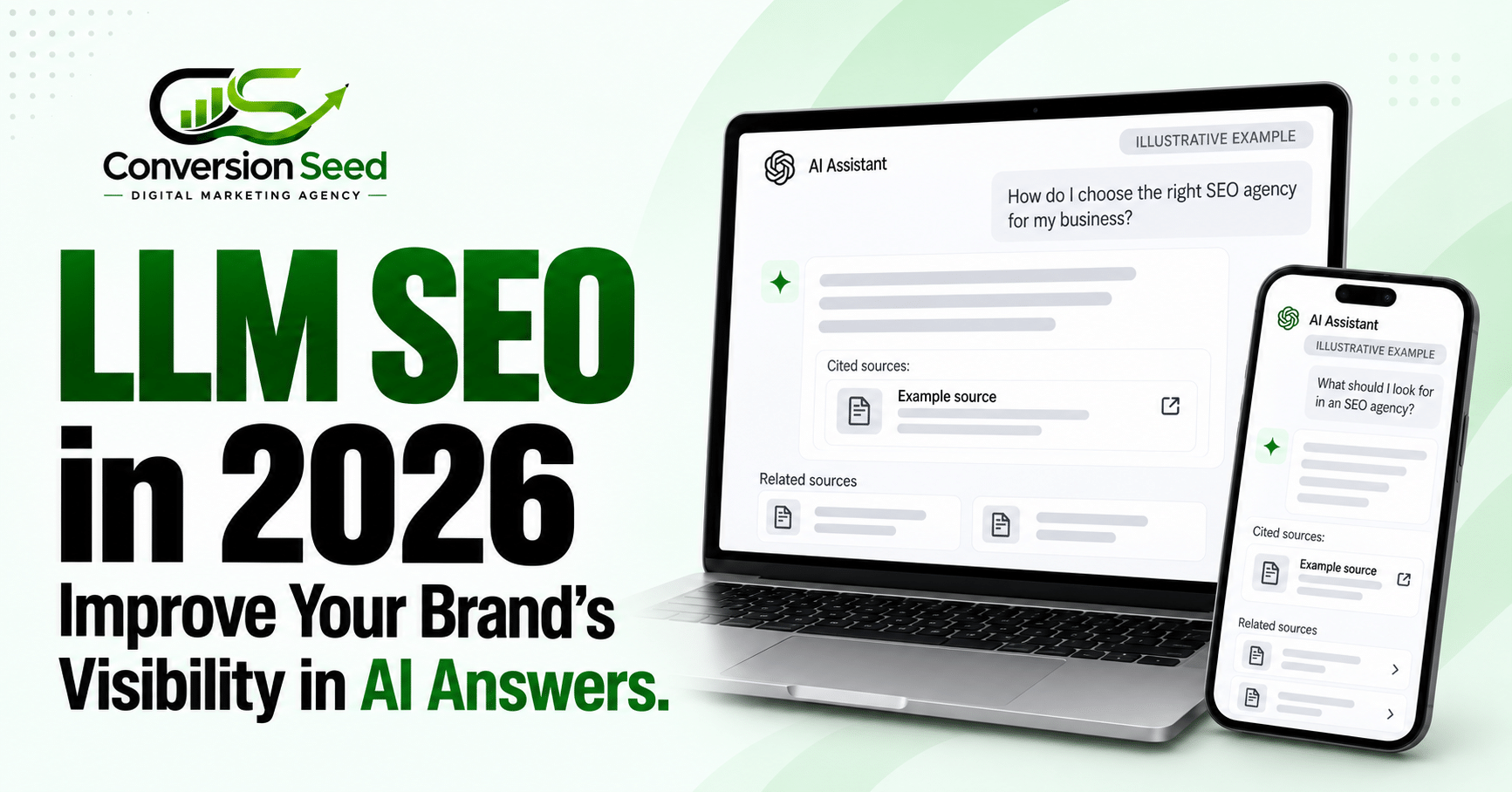
A prospect asks an AI assistant to recommend a service provider. The answer may name companies, summarize their work and cite web pages. If your business is absent, described inaccurately or linked to an outdated page, a potential customer may never reach your website.
LLM SEO is the practice of improving how clearly a business can be discovered, understood and represented in answers generated by large language model systems. It is often discussed alongside generative engine optimization (GEO) and answer engine optimization (AEO). These are industry terms, not separate ranking systems with a universal checklist.
LLM SEO cannot force an assistant to recommend a brand. Different systems retrieve information differently, answers vary by question and location, and a mention may appear without a website visit. The sensible goal is to publish accurate, accessible information that helps both people and systems evaluate the business—and to track whether that visibility supports qualified enquiries.
Some AI experiences retrieve current pages from a search index or the open web to support an answer. Others may rely on different sources or product-specific workflows. A business should therefore avoid assuming one crawler setting or one page format controls every AI platform.
Google says its generative Search features draw on its existing Search systems and recommends the same foundations used for search visibility. OpenAI documents separate controls for its search crawler and its model-training crawler. Those are platform-specific policies; choose access settings based on your own publishing and privacy goals. Sources: Google’s AI optimization guide and OpenAI crawler documentation.
The practical implication is simple: if a company’s services, locations, credentials and answers are hard to find or contradictory across its own pages, an AI-assisted answer has less reliable information to work with.
| Question | Conventional search focus | Additional LLM SEO focus |
|---|---|---|
| What should the page answer? | The searcher’s intent and target topic. | The specific questions and follow-ups a buyer might ask an assistant. |
| What builds confidence? | Helpful content, relevant links and a usable site. | Verifiable facts, clear attribution and consistent descriptions of the business. |
| What is measured? | Impressions, clicks, rankings and leads. | Observed citations or mentions where measurable, referral context and qualified leads. |
| What is the technical foundation? | Accessible, indexable pages and coherent site structure. | The same foundation, plus platform-specific crawler checks where relevant. |
The overlap is substantial. A detailed service page that explains its scope, process, audience and limitations serves a person well regardless of how that person found it.
Make core facts easy to verify on your website: business name, service areas, location, contact details, services, intended customers and who delivers the work. Update old profiles and citations when the business changes.
For Conversion Seed, agency partners and direct business clients need different explanations. White label SEO pages should clearly explain confidentiality, handoffs and reporting; an AI SEO service page should describe its audit and implementation scope. A concrete capability or documented example answers a buyer’s question better than a vague “best agency” claim.
Map the questions buyers ask before contacting you:
Place concise answers near the top of a relevant page, then give useful detail, examples and limitations. A quick definition alone seldom resolves a buying decision.
Publish approved case studies, clear methodologies, named expertise, current service details and evidence that can be checked. An anonymized case study can still explain the initial problem, actions taken, measurement method and outcome if the client has approved publication and the numbers are verified.
Where original data is unavailable, make the article useful through an honest worked example or checklist and label it as illustrative. Do not present a hypothetical scenario as a client result.
Check that priority pages can be reached, render meaningful text, return the expected status code, use sensible canonical URLs and connect through internal links. A public article hidden by noindex or blocked from the relevant crawler may not serve the intended discovery goal.
Crawler access is a policy choice. OpenAI says OAI-SearchBot relates to search discovery while GPTBot relates to model training; their controls are independent. Review the latest official documentation before changing robots.txt, and do not claim that permitting any crawler guarantees inclusion. Source: OpenAI crawler documentation.
Relevant structured data can help search engines understand information about a page and may support eligible search features. It should reflect the page’s visible content and follow each feature’s rules. Google says no special structured data is required for its generative Search features. Adding FAQPage, Organization or another type cannot guarantee an AI citation. Sources: Google’s structured data introduction and AI optimization guide.
Record a small, stable set of representative buyer questions and check how the brand appears in the relevant AI experiences. Note the date, location or account context when possible, exact question, whether the brand is mentioned, cited URL and whether the description is accurate. Treat this as a sampled observation, not a complete measure of every possible answer.
Complement manual checks with available first-party reports. Google introduced dedicated Search Console views for generative AI visibility in Search and Discover. Bing Webmaster Tools introduced an AI Performance dashboard in public preview that includes citations and cited pages. Dashboard availability and definitions can change, so review each platform’s current reporting notes. Sources: Google Search Central announcement and Bing Webmaster Tools announcement.
Finally, compare AI-related referral visits where identifiable, engaged sessions, demo requests, calls and qualified leads. A citation without a click may still have brand value, but the available data rarely proves that a particular mention caused a sale.
Review service descriptions, location details, team information, prices and claims whenever they change. Update pages that answer an important buyer question incompletely. A periodic content review is more useful than generating dozens of near-identical “best of” pages.
Imagine a SaaS consultancy that offers implementation and support for UK clients. The website says “global solutions,” but does not explain which platforms it supports, its UK availability or its onboarding process. The business appears inconsistently in a handful of public profiles.
An audit would first verify crawl and index access. It would then compare the site’s service claims with public listings, map buyer questions, improve the service and FAQ copy, and document which details need approval from the consultancy. Finally, it would establish baseline search and AI visibility observations and monitor enquiries after the changes. This is an illustrative workflow, not a promised outcome.
llms.txt?Some publishers experiment with llms.txt as a way to describe site content to AI tools. It should not be treated as an established ranking factor or a required step for Google Search. Google’s current guidance says its generative Search features do not use llms.txt files or require special AI-readable files. If a business maintains one for other workflows, keep the information accurate, but prioritize the pages people and search systems can already access. Source: Google’s AI optimization guide.
Is LLM SEO the same as GEO or AEO?
The terms overlap. LLM SEO emphasizes how a brand appears in answers involving large language models; GEO and AEO are broader industry labels for visibility in generated or direct answers. The work should be defined by specific pages, systems, questions and business outcomes rather than by a label alone.
Can I guarantee that my business will be recommended by an AI assistant?
No. Answers depend on the question, system, available sources and context. An agency can improve the quality and accessibility of the information about a business, then measure observable changes; it cannot control every answer.
Will allowing an AI crawler improve my rankings?
Crawler settings govern access in specific contexts. They do not by themselves guarantee an answer, citation, ranking or qualified lead. Review each provider’s documented policy before making changes.
What is the best first step for a small business?
Start with the pages that explain what you do, whom you serve and how to contact you. Correct factual gaps, confirm that important pages are accessible and build a baseline of search visibility and enquiries before adding new content.
Strong LLM SEO begins with trustworthy business information and pages that answer real buyer questions. Conversion Seed combines technical SEO, content strategy and AI visibility reviews to help agencies and businesses identify gaps, prioritize fixes and measure useful outcomes.
Request a Free LLM SEO Audit: Share your website and priority services with Conversion Seed to identify visibility gaps, unclear business information and opportunities to earn more relevant enquiries. Visit conversionseed.com to get started.
Elevate your online presence with Conversion Seed trusted Digital Matketing strategies and solutions.