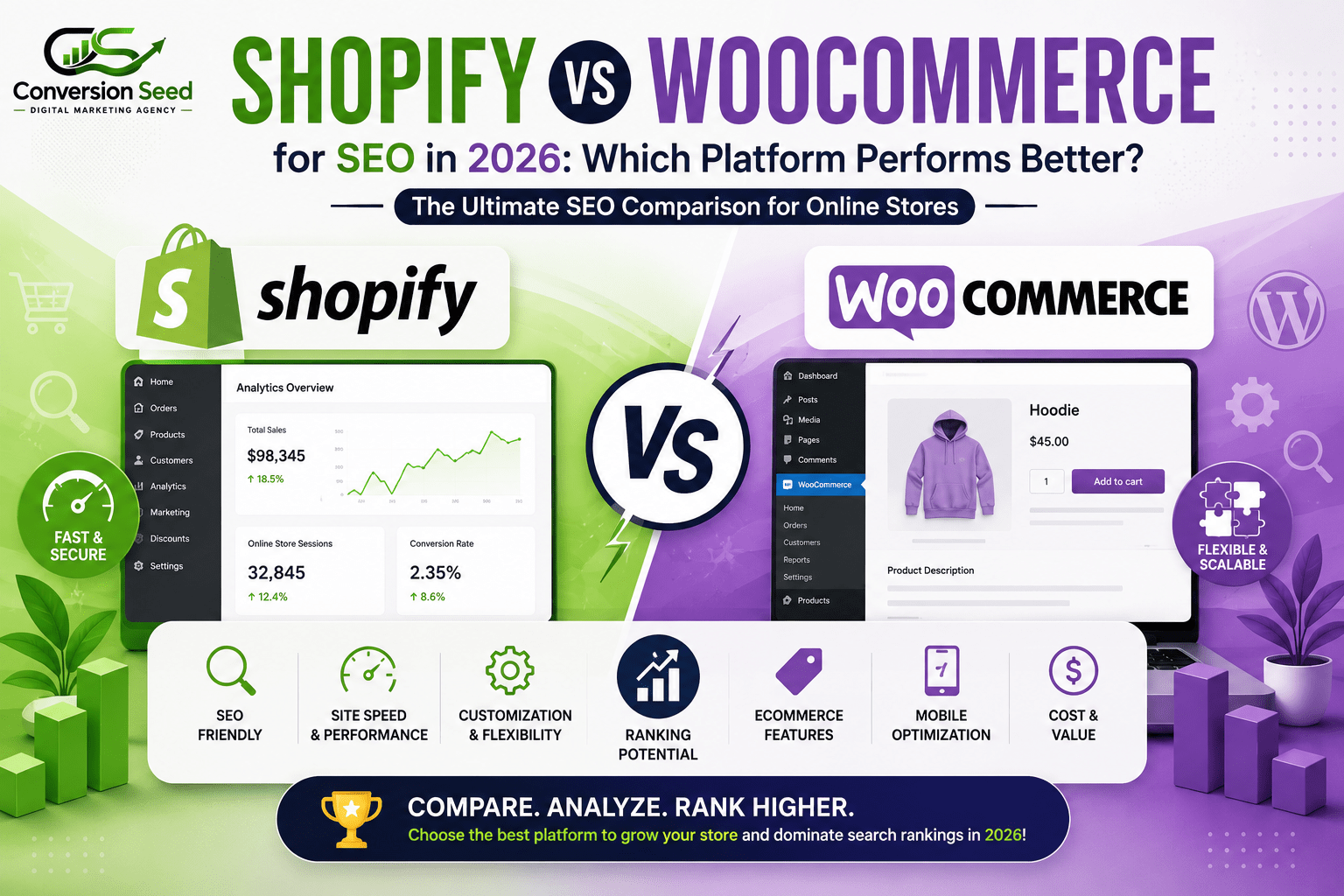
If you’re building an online store in 2026, you’ve probably asked yourself: Should I choose Shopify or WooCommerce for better SEO? Both platforms are huge, both can help you rank, but they work very differently. Let’s break it down in simple, clear words so you can make the right choice for your business.
Before we compare Shopify and WooCommerce, let’s remember what actually matters for SEO:
The platform you choose affects some of these, but your content, structure, and effort matter more than the platform itself.
Shopify is a hosted platform — everything runs on their servers. This makes it very easy to start and very stable.
SEO advantages:
Fast by default – Shopify handles hosting, security, and updates for you
Mobile-friendly themes – Most Shopify themes are built for phones
Built-in SEO features – You can edit meta titles, descriptions, and URLs easily
Simple setup – Great for beginners who don’t know technical SEO
Clean URL structure – Shopify creates logical URLs automatically
Shopify is incredibly straightforward to handle, and most things work straight out of the box.
In 2026, Shopify signed an agreement with ChatGPT. This means Shopify stores will start appearing more in large language models like ChatGPT, which is changing how people find products online.
Over time, this built-in ChatGPT integration will help Shopify stores dominate both Google search and LLM visibility.
WooCommerce does not have a similar agreement yet, which is a real disadvantage in 2026.
Less technical flexibility – You can’t change deep server settings
URL structure is fixed – Shopify adds /products/ or /collections/ to URLs
Monthly cost – You pay every month, even if you don’t sell much
WooCommerce is a plugin for WordPress. This means you own everything and control everything.
SEO advantages:
Full technical control – You can edit anything on your site
Greater SEO flexibility – Install any SEO plugin (like Yoast, Rank Math)
Custom URL structure – You can make URLs exactly how you want
No monthly platform fee – You only pay for hosting and plugins
Huge plugin library – Thousands of WordPress plugins for SEO
WooCommerce appears to offer greater technical SEO flexibility than Shopify.
Requires more work – You must manage hosting, updates, security
Can become chaotic – If not managed properly, site speed and structure can suffer
Slower if poorly hosted – Your hosting choice affects speed directly
More technical knowledge needed – You need to understand WordPress
WooCommerce offers greater control, but it can become chaotic if not managed properly.
After using both platforms, many SEO experts say: I don’t notice a major SEO gap between Shopify and WooCommerce.
Here’s the truth:
Shopify is outperforming WooCommerce when it comes to the organic visibility of stores.
The difference isn’t really the platform itself but how it’s used.
Rankings ultimately hinge on:
Content quality
Site structure
Backlinks
If you do these well, both platforms can rank great. If you do them poorly, neither will help you.
You pay monthly, but everything is handled for you.
WooCommerce can be cheaper, but you need to handle more work yourself.
Choose Shopify if:
✅ You want quick setup and simplicity
✅ You’re new to SEO or ecommerce
✅ You don’t want to manage hosting or updates
✅ You want built-in reliability and speed
✅ You care about LLM visibility (ChatGPT integration)
✅ You want better organic visibility for your store
I choose Shopify for quick setup.
Choose WooCommerce if:
✅ You need more flexibility and control
✅ You already know WordPress
✅ You want custom URL structures
✅ You’re comfortable managing hosting, security, updates
✅ You want lower monthly costs
✅ You need deep technical SEO control
I choose WooCommerce when I need more flexibility.
WooCommerce has more plugin options for advanced SEO.
Shopify:
Fast by default (hosted on their servers)
CDN included
No setup needed
WooCommerce:
Speed depends on your hosting
You need to choose good hosting
May need caching plugins
If you pick bad hosting for WooCommerce, your site will be slow, and Google will penalize you.
Both platforms offer mobile-friendly themes, but:
Shopify themes are mobile-optimized by default
WooCommerce depends on your WordPress theme choice
For most users, both work well on mobile in 2026.
Here’s the honest truth from people who’ve used both:
“It seems the difference isn’t the platform itself but how it’s used.”
“In my experience, rankings hinge more on content, site structure, and backlinks than on the platform itself.”
This means:
A well-optimized WooCommerce site can beat a poorly optimized Shopify site
A great Shopify store can rank better than a bad WooCommerce store
Your effort matters more than the platform
Shopify wins for:
Beginners
Quick setup
Reliability
Built-in SEO features
Better organic visibility
ChatGPT/LLM integration
WooCommerce wins for:
Technical SEO control
Custom URL structures
Lower costs
Full ownership
If you’re starting a new ecommerce store in 2026 and want the best SEO results with less work, choose Shopify.
If you’re tech-savvy, already know WordPress, and want maximum control, choose WooCommerce.
But remember: The platform won’t make or break your SEO. Your content, structure, and backlinks will.
Before deciding, ask yourself:
Do I want easy setup? → Shopify
Do I need full control? → WooCommerce
Am I new to SEO? → Shopify
Do I know WordPress? → WooCommerce
Do I care about LLM visibility? → Shopify
Do I want lower monthly costs? → WooCommerce
Shopify is simpler, faster to set up, and in 2026 has a real advantage with ChatGPT integration and better organic visibility.
WooCommerce gives you more control and flexibility, but requires more work and technical knowledge.
For most ecommerce businesses in 2026, Shopify performs better for SEO because it’s easier to use correctly and has new AI advantages. But if you’re experienced and want full control, WooCommerce can match Shopify if you do the work right.
The best platform is the one you’ll use properly. Focus on content, structure, and backlinks — those matter more than the platform itself.
Elevate your online presence with Conversion Seed trusted Digital Matketing strategies and solutions.